ESIIL’s 2026 Innovation Summit: Empowering a Broad Community to Advance AI for Sustainability
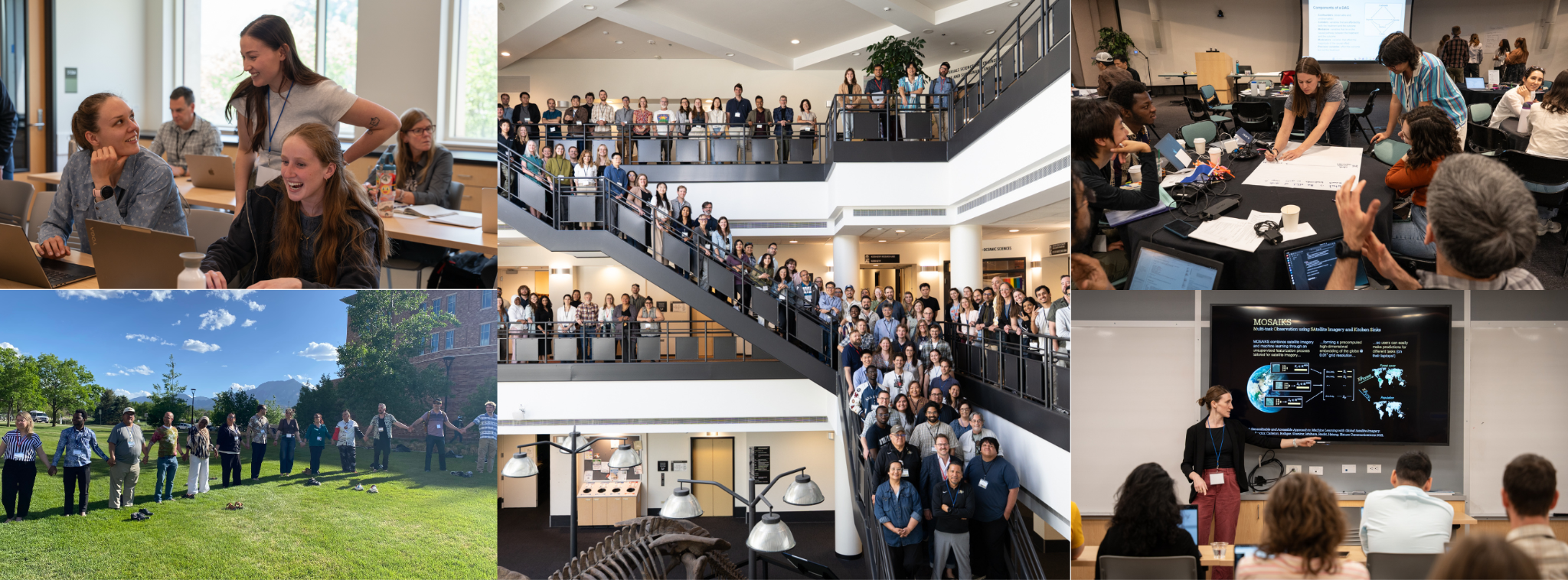
In May, ESIIL hosted its fourth annual Innovation Summit focused on AI for Sustainability, bringing together 131 participants from 72 unique institutions. The Summit aimed to:
- Inspire novel AI approaches that unlock the potential of environmental data
- Grow AI and data skills capabilities in the next-generation workforce
- Build transdisciplinary collaborations and emergent teams across sectors to facilitate data-driven co-development
- Learn, workshop, and create best practices in environmental data science and the responsible use of AI
Leading up to the Summit, ESIIL held three virtual pre-Summit training events. Two technical sessions introduced participants to CyVerse and GitHub, ensuring everyone could fully engage. The third event, the Science Jam, enabled participants to explore AI for sustainability topics, expand on questions gathered from application forms and start forming groups around topics of interest.
The Summit opened with a traditional Lakota blessing delivered by Phil Two Eagle, Executive Director of the Sicangu Lakota Treaty Council, reminding attendees of our responsibility to each other and our planet. Waleed Abdalati, CIRES Director, highlighted CIRES and ESIIL’s role in translating data into discovery and decision-making, emphasizing the importance of this event. CU Vice Chancellor for Sustainability Andrew Mayock expressed pride in hosting a national summit to explore responsible and fair use of evolving technologies such as AI to steward natural heritage.
The central question guiding the Summit was: How can we leverage the environmental data and AI revolutions to make decisions over the next 10 years that set our nation’s species, ecosystems, and environmental livelihoods on a course towards a thriving future?
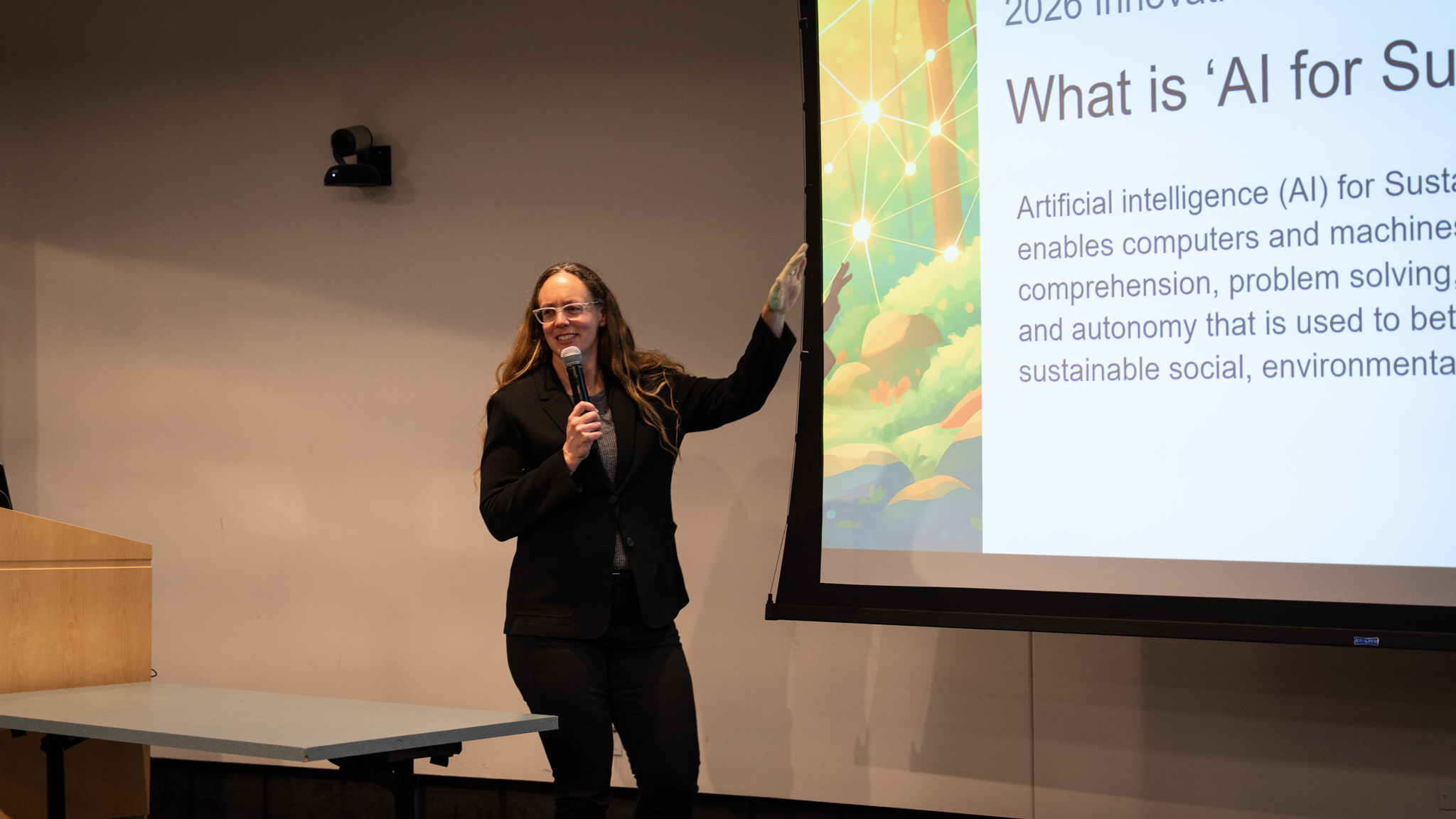
ESIIL’s Director Jennifer Balch outlined tensions the Summit aimed to hold while advancing innovative team science:
- AI for Sustainability ≠ Sustainable AI
- Slow build of relationships ≠ Rapid pace of data
- Individual contributions ≠ Large-team science
- Traditional ecological knowledges ≠ Euro-centric science
- Practical solutions ≠ Science innovation
- Sustainability is a long game ≠ We need solutions now
New this year, participants chose from training sessions on Earth Embeddings, Causal Inference, Large Language Models (LLMs), or Digital Twins. These trainings introduced cutting-edge techniques such as encoding earth data into vector representations, using cyberinfrastructure and AI tools to build near real-time data streams, using agentic repositories for scientific work, and fusing causal inference with machine learning and AI.
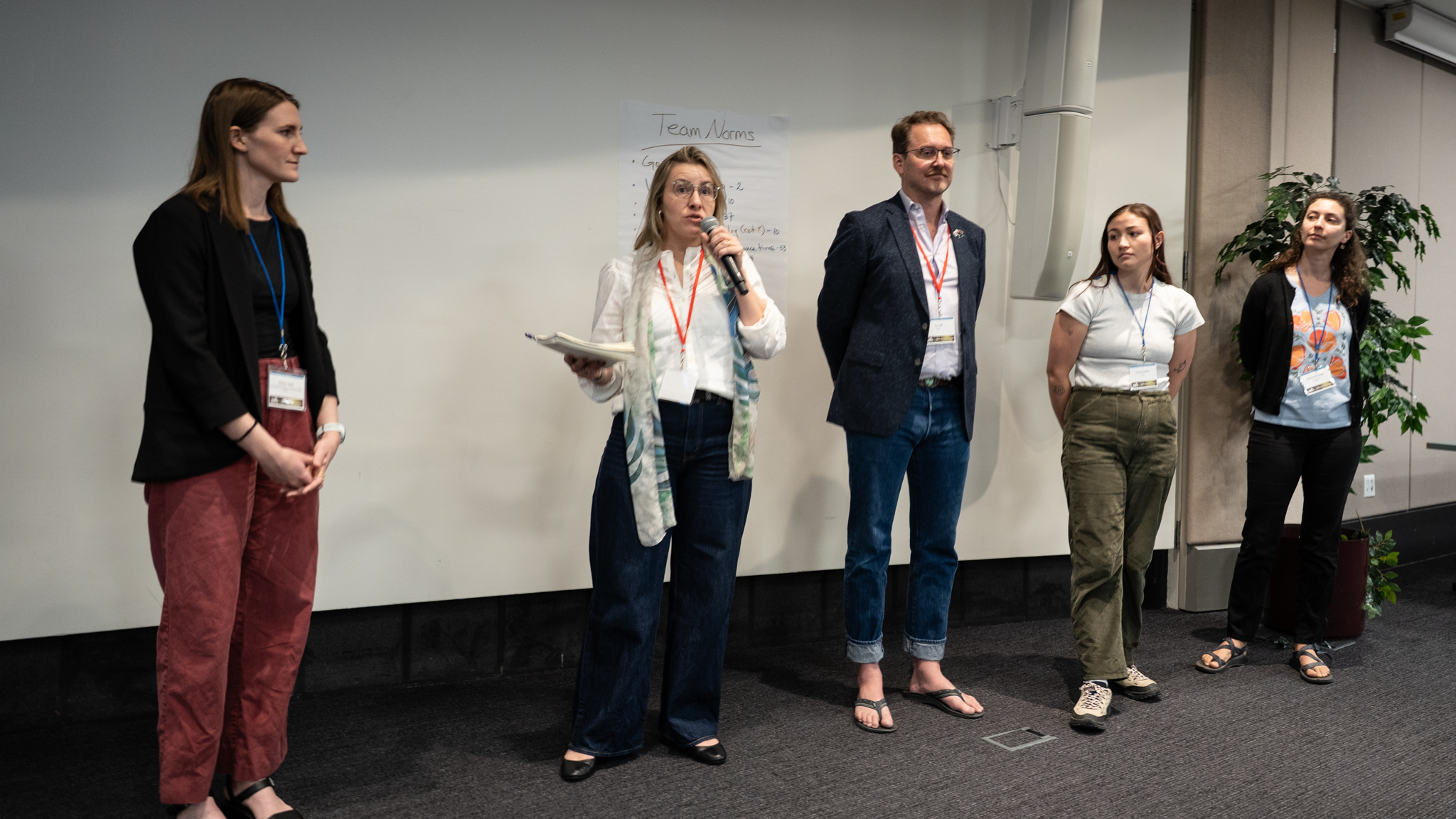
Guided by the Divergent Science facilitation team, 16 teams self-organized by the end of day one to apply their training and interests to topics such as food systems and agriculture, energy systems and climate mitigation, AI methods and modeling, earth observations and digital twins, and policy and decision making.
Day two included reflections on AI use and transparency issues for teams teams and a talk by Tanya Berger-Wolf, director of the Translational Data Analytics Institute on AI for the multiscale, multimodal, and multisensory world. Teams continued working on their projects documenting their work on GitHub, and presenting their progress to the larger group.
On the final day, CIRES and NOAA research scientist, Youmi Oh presented her work as the PI for the ESIIL AI for Natural Methane Working Group. Their work integrates multi-scale observations with knowledge-guided machine learning for next-generation modeling of global natural methane fluxes. Many Summit teams go on to apply for and become ESIIL working groups to continue their work from the Summit. With Youmi’s inspiration, teams continued to work on their projects applying key learnings from the trainings and pulling together data from ESIIL’s data library. Teams finalized their work and presented their approaches, results, and next steps.
Highlights of team achievements included:
- Developing scalable AI workflows to streamline energy consumption reporting in environmental studies
- Creating AI-assisted social media analysis pipelines for wildfire event response insights
- Constructing conceptual AI domain maps to guide ethical and critical AI use in communities
- Building AI agents to harmonize multidisciplinary data from PDFs for research synthesis
- Leveraging embeddings for ecological risk mapping, land classification, and agricultural detection
- Producing podcasts and inventories of earth embedding models as educational resources
- Designing environmental science classroom modules to teach AI and data literacy
- Applying Graphical Neural Networks to ecological restoration and biological communities
- Detecting urban tree canopy changes and ecological risk with GeoAI
- Generating high-resolution soil moisture maps using earth observation embeddings
- Combining embeddings and digital twins for real-time wildfire burn area prediction
- Clustering global urban land cover data with socio-economic correlations
- Mapping mining claims and water impacts using LLMs and data harmonization
- Integrating AI tools with physics-based models for sensor data correction
- Creating workflows for AI spatial data harmonization and analysis
- Developing AI agents to analyze complex tree physiology data from Costa Rica
The Summit closed with reflections from Oglala Lakota College faculty, Elisha Yellow Thunder and Jennifer Balch emphasizing intentional innovation and preserving humanity in the process. Phil Two Eagle and James Rattling Leaf, Sr. led a traditional closing with all participants joining hands in gratitude.