Announcing ESIIL's Third Cohort of Working Groups
ESIIL had a record number of proposal submissions this year with a truly inspiring level of enthusiasm and commitment to advancing environmental data science. We extend our heartfelt thanks to everyone who dedicated time and effort to develop and submit an application for ESIIL’s call for working groups.
After thoughtful review, we are thrilled to announce the selection of ESIIL’s third cohort of working groups! These ten dynamic teams will be instrumental in advancing our mission to foster an integrative, interdisciplinary approach to environmental data science. By bringing together broad expertise, they will collaboratively address pressing environmental challenges and work towards innovative, data-driven solutions.
Congratulations to:
Advancing Global AMF Biogeography and Diversity with Long-Read Sequencing and Open Tools (AMF Biogeography & Diversity)
PI: Dr. Camille S. Delavaux (Netherlands Institute of Ecology)
Co-PIs: Dr. James D. Bever (University of Kansas), Dr. Robert Ramos (Stony Brook University)
Most plants rely on arbuscular mycorrhizal fungi (AMF) for access to limiting nutrients, underpinning terrestrial ecosystem health and resilience. Yet, scientists still struggle to identify the full diversity of these underground microbes and to map where they occur across the Earth. Our team will tackle this challenge using cutting-edge DNA sequencing and data science to build better tools for identifying AMF. This will result in openly accessible databases and software to empower researchers everywhere. Together, this work will enable a better understanding of AMF diversity and global distribution, key information for sustainable agriculture and ecosystem restoration.
Advancing Research and Discovery: GenAI Training for Environmental Scientists (AI in a Day)
Co-PIs: Li Kui (University of California, Santa Barbara), Sarah Elmendorf (University of Colorado), Stevan Earl (Arizona State University), Nick Lyon (National Center for Ecological Analysis & Synthesis (NCEAS); Long Term Ecological Research (LTER) Network Office), Nate Emery (University of California, Santa Barbara)
Generative Artificial Intelligence (GenAI) tools such as ChatGPT, Google Gemini, and GitHub CoPilot are rapidly transforming environmental science, yet many researchers lack a foundational understanding of these tools and the time or resources to learn them. To bridge this gap, we propose “AI in a Day”: a suite of open-access, community-driven training modules that equip environmental scientists to integrate AI effectively and responsibly into their research. Delivered through ESIIL workshops, conferences, and online platforms, modular materials will provide practical, up-to-date guidance that democratizes AI knowledge and empowers scientists across career stages to engage fully in the evolving landscape of AI-enabled environmental science.
CMSMapper: Optimal climate mitigation planning for nature and people (CMSMapper: Climate Planning)
Co-PIs: Evelyn Beaury (New York Botanical Garden), Laura Nunes (Defenders of Wildlife)
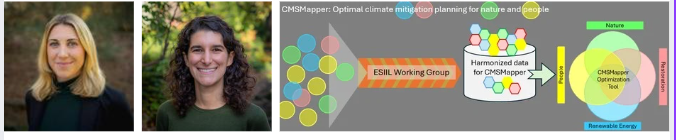
The U.S is amid two environmental crises: a climate crisis due to rising carbon emissions and a biodiversity crisis due to unprecedented ecosystem degradation driving loss of species. At the same time, economic and technological growth demands higher energy production. The expansion of the U.S energy grid must co-occur within a landscape matrix that also considers climate and biodiversity priorities. Alongside these land use trade-offs, there is also a need to consider consequences of land use planning on socio-economic issues such as human health, livelihood and social inequities. Activities to reduce or sequester carbon emissions, or climate mitigation strategies (CMS) are essential to address the climate crisis with some CMS, such as ecological restoration, also having benefits to biodiversity. Over the years, there has been growing literature on the interactions between CMS, nature and people. However, these disparate datasets have not been reconciled for decision making across regions in the U.S. The development of evidence-based guidance on optimal CMS planning requires cross-sectoral expertise, data synthesis, and the production of open, harmonized data products. This multidisciplinary working group aims to overcome this barrier by leveraging the best available data and robust technological infrastructure. These products can be integrated into impact assessments of CMS activities on nature and people and predictive scenarios for CMS planning to support a strategic expansion of the U.S energy grid that operates in synergy with environmental resilience and social equity.
Linking Food Web Theory with Global Data to Quantify Plankton Trophic Interactions (Worldwide Changing Plankton)
PI: Tyler Butts (University of Minnesota-Twin Cities)
Co-PIs: Michael Meyer (U.S. Geological Survey), Chase Rakowski (University of Colorado - Boulder), Stephanie Figary (University of Vermont), Jason Stockwell (University of Vermont), Celia Symons (University of California, Irvine), Rachel Pilla (Oak Ridge National Laboratory)
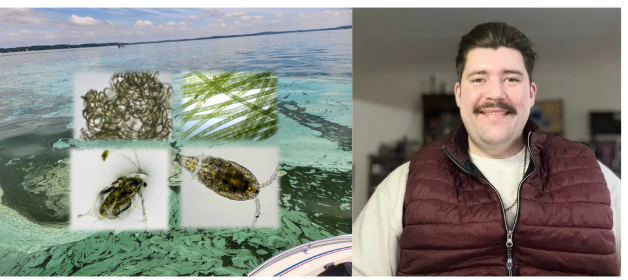
Freshwater ecosystems provide ecological, cultural, and economic benefits yet remain threatened by worldwide biodiversity loss and understudied compared to terrestrial and marine ecosystems. Furthermore, while zooplankton are key drivers of ecosystem function within lakes, providing food for fish to grow and grazing phytoplankton (i.e., algae) to manage water quality, important questions remain regarding zooplankton biodiversity response to global change and how these changes may influence zooplankton-algae trophic interactions. Changes in the diversity of zooplankton worldwide can lead to excess algal growth negatively impacting water quality, human health, tourism, and property values. Using the largest dataset of zooplankton freshwater biodiversity we will quantify the breadth of zooplankton thermal tolerances as well as their composition across different climate regimes worldwide. Then, by integrating this zooplankton dataset with the largest dataset of algal freshwater diversity we will address how trophic interactions have been changing over time and across the globe. We will accomplish both of these goals relying on new and established effective team science methods, drawing from the group’s diverse background and expertise, and share our results and data broadly.
Nature's Blueprint for Resilience: Tracking the Organization of Biodiversity in a Changing World (Vegetation network shifts)
Co-Leads: Annie Meeder (University of Colorado Boulder), Dr. Katharine Suding (University of Colorado Boulder)
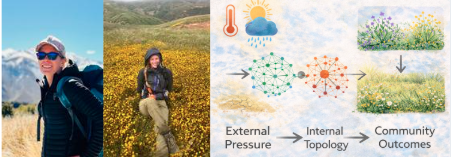
Climate change and human disturbance are rapidly transforming plant communities. Yet, we still struggle to recognize when and how ecological communities are reorganizing. This working group will pair the development of statistical approaches that detect these transformations by studying the networks of species interactions with analyses of global time series data. Instead of looking only at which plants are present or how much ground they cover, we focus on the web of connections that keep ecosystems functioning--and how these connections shift under increasing stress. Around the world, scientists have been collecting detailed records of plant communities for decades, but these rich datasets have not been used to understand the relationships among species. By applying newly-developed methods to some of the most influential estimates of global biodiversity and distributed global change experiments in policy and science, , we will ask: does the internal organization of biodiversity influence how a system responds to environmental pressures?
NEON-SYNC: Drivers of ecological synchrony across taxa and trophic levels (NEON-SYNC)
PI: Tong Qiu (Nicholas School of the Environment, Duke University)
Co-PIs: Allen Hurlbert (University of North Carolina, Chapel Hill), John M. Grady (St. Mary’s College of Maryland), Phoebe Zarnetske (Michigan State University)
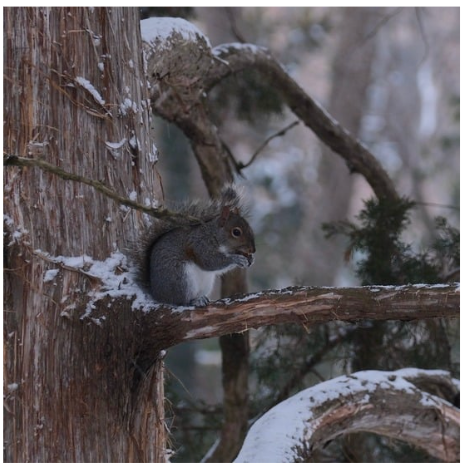
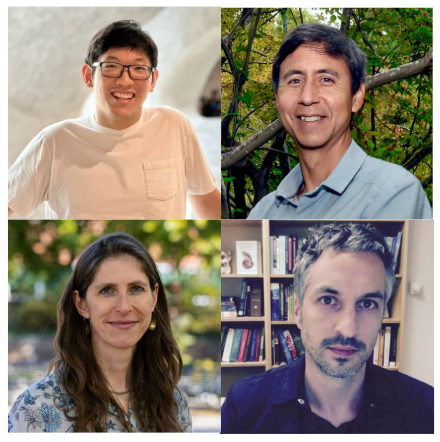
Populations of different taxa often rise and fall together through time—a pattern called temporal synchrony—but sometimes they move in opposite directions or not at all. These rhythms can either steady ecosystems or make them more vulnerable to sudden change. Using NEON, a monitoring network which tracks many kinds of organisms across U.S. ecosystems, we will measure how strongly pairs of groups (for example, insects and the birds that eat them) move together, and how those patterns depend on species’ traits (like how fast they reproduce or what they eat) and local conditions (climate extremes, productivity, and disturbance such as fire or floods). We will generate tools that provide early warning and practical guidance for conservation—helping managers prioritize vulnerable food-web links and focus monitoring where coordinated declines are most likely under global change.
Redefining ectotherm thermal tolerance in a variable climate using big data (Thermo ToleRate)
PI: Kelsey Lyberger (Arizona State University)
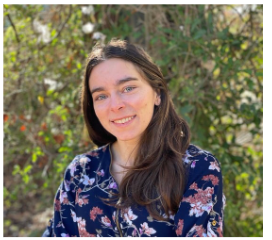
As climate change drives more frequent and intense heatwaves, it has become essential to quantify not just how hot, but for how long, because survival in ectothermic animals depends on the joint effects of temperature and exposure duration. Traditional single- point tolerance metrics therefore provide an incomplete and sometimes misleading picture of vulnerability under natural thermal variability. This project brings together data scientists, ecologists, and physiologists to develop a database of physiological performance and survival across combinations of temperature and exposure time. Using advanced models, we will build “tolerance surfaces” that describe how animals respond to heat stress, and test these models against real-world data on populations such as mosquito abundance at sites across the US and long-term marine zooplankton records. Our findings will improve predictions of how temperature extremes shape population dynamics and reveal when physiological limits can explain observed ecological patterns.
Responses of terrestrial ecosystem properties to degree of invasion (Ecosystems under invasion)
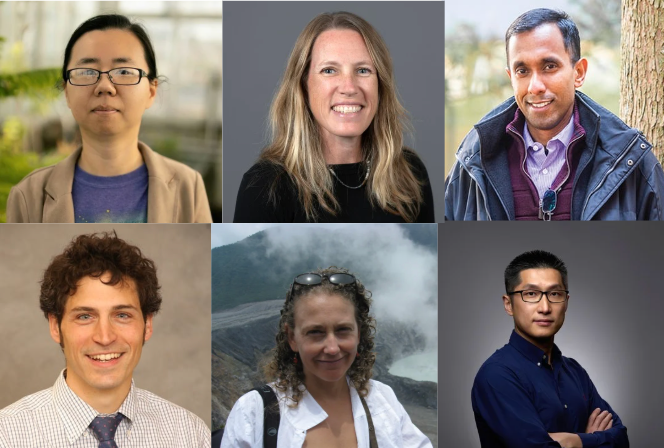
PI: Yingying Xie (Northern Kentucky University)
Co-PIs: Thilina Surasinghe (Bridgewater State University), Diane Styers (Western Carolina University), Mary Beth Kolozsvary (Siena College)
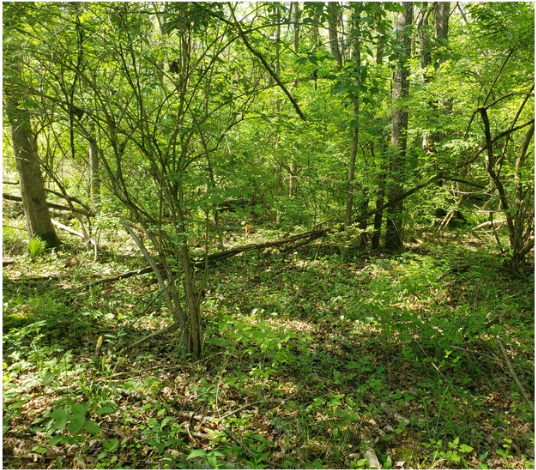
Biological invasion severely disrupts ecosystems and human societies by compromising ecosystem services and complicating conservation actions. To mitigate invasion impacts with limited resources, understanding ecosystem-scale sensitivity to the degree of invasion is critical for developing effective management plans. However, evaluations of ecosystem responses to biological invasions are often limited to simple comparisons between native and invaded communities, thus it remains unclear how ecosystem functions and services change along the gradient of invasion and how these responses vary among ecosystems, dominant invaders, and environmental conditions. Our working group will address these questions by integrating diverse environmental data sources from various terrestrial ecosystems using the advanced computational resources available through ESIIL to investigate how ecosystem properties are affected by biological invasion. This project will improve our understanding of biological invasion and the assessment of their impacts on ecosystem functioning and services.
Sensor Synthesis at the Edge: Scalable Environmental Insights from Real-time Data (EdgeSS)
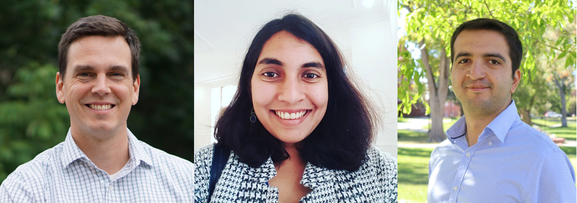
PI: Matthew Helmus (Temple University)
Co-PIs: Mostafa Javadian (Northern Arizona University), Priyanka deSouza (University of Colorado Denver)
Understanding environmental changes such as the spread of invasive species, shifts in seasonal patterns, and worsening air pollution, requires new ways to gather and analyze information quickly. Today, cutting-edge tools like smart sensors and artificial intelligence are making it possible to track these changes in real time. This project will bring together scientists who study the environment with experts in data and computing to find the best ways to combine different kinds of information from across the country. We will focus on three real-world problems that affect people and nature: the spread of the Spotted Lanternfly, an invasive insect threatening farms and forests; how wildfires and other disturbances affect bird life and plant seasons; and how pollution levels vary across states and impact environmental and public health. To study these challenges, we will use the growing network of smart sensor continuous data-streaming stations placed across the U.S. These stations can detect insects, sounds, temperature, weather, and pollution in real time—and make decisions right where the data are collected. Our group will meet three times to develop tools, share knowledge, and design new ways to use these technologies. To build community outreach, we will host webinars and a virtual hackathon to involve computer science students and outside collaborators. All results, tools, and findings will be made freely available online to help scientists and the public make decisions based on real-time environmental insight. This project will help shape the future of how we monitor, understand, and respond as a nation to environmental change.
Wopasi Pazo: Sharing Findings from Looking at the Water & Writings on the Earth (Wopasi Pazo)
Project Leader: Sierra Hicks (Cornell University)
Co-Leaders: Esmee Mulder (University of Colorado Boulder), Phil Two Eagle (Sicangu Lakota Treaty Council), Alicia Swimmer (Sicangu Lakota Treaty Council)
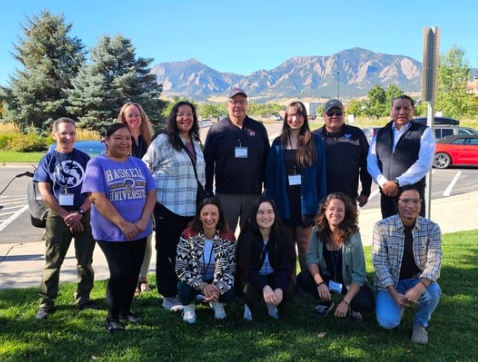
Wopasi Pazo is an Indigenous-led initiative creating a sovereign environmental data system for the Oceti Sakowin Oyate. Rooted in the teaching Mni Wiconi—“Water is Alive”—it protects the White River, Cheyenne River, Missouri River, and sacred Black Hills, all threatened by mining, pollution, climate change, and aquifer loss. For generations, Tribal Nations lacked fair access to environmental data. Wopasi Pazo changes this by building tribally governed systems grounded in Lakota knowledge and treaty rights, advancing data science, enabling everyday language queries, and strengthening Tribal capacity to use AI for justice, sovereignty, and ecological governance.